
When we think of homelessness we the image is usually of people sleeping out on the streets, but there is a huge underworld of hidden homelessness – sleeping on friends floors, in hostels and B&Bs.
There are now twice as many people are living in emergency accommodation than in 2010. The number of homeless children has increased by 42% and the number of disabled homeless by 39%.Eviction rates are higher now then the were even at the hight of the financial crisis.Although London has been worst hit, but the rest of the country is also suffering. St Petrocks in Exeter reported an 26% increase in people needing their help. During the last year there has been a 30% increase in rough sleeping.
Although there are many different causes for the increase in homelessness, there seem to be a few reoccurring widespread issues.
Changes to Benefits
One of the major factors are the changes to the benefit system.
The Bedroom Tax: In 2013 the government brought in what they called the ‘spare room subsidy’ for people on housing benefit who are judged as having too rooms. Previously if you were a single person in a two bedroom flat you would be able to claim the standard rate for that property. With the implementation of the bedroom tax that person would only receive housing benefit for a one bedroom property, and would either have to pay the extra rent themselves or face eviction. It was created on the basis it would encourage people to move from larger to smaller properties, but only 6% of those affected have actually moved. This is mostly because there are very few one bedroom flats in housing association property meaning that even if people want to move, they can’t.
Benefit Cap: A cap of £20,000 a year has been placed on the amount of housing benefit people can claim. This has left large areas of the country, especially in London and the south east, completely unaffordable for families. The cap has even been put on sheltered or supported housing, meaning that 50,000 of the most vulnerable people – the elderly, people mental health problems, victims of domestic violence will either have to pay the rent shortfall themselves or risk homelessness.
This also has an impact on housing associations who are left with tenants who can’t pay their rent, and insufficient funds for repairs and maintenance.
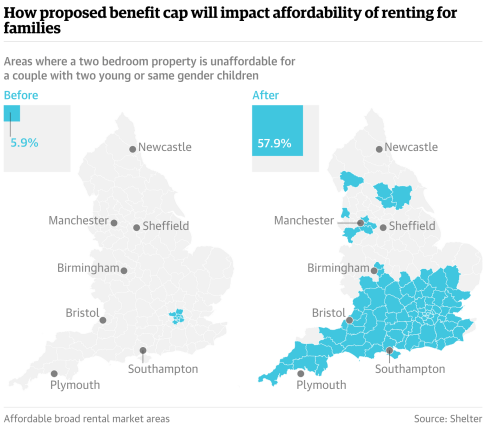
Local Housing Allowance: The way that housing benefit is calculated for people in the private rental market has also changed. Before it was based on the median rate of private rental prices in an area, roughly in the middle. Now it is based on the bottom 30th percentile, i.e. under 30% of the rent.
The size of the area used to calculate this (called a Broad Market Rental Area) can be huge. So, for example, despite the fact that rental prices wildly differ in Exeter it is treated as one large area, and the LHA you receive in St Thomas’ is the same as if you were living in the city centre. So, wherever you are in Exeter, a limit of £350 per month for a house share, and £530 per month for a one bedroom flat.
It is particularly difficult for disabled people like myself. I live, by necessity, on the ground floor in the centre of town. Even though that is more expensive than a first or second floor flat and to live in central Exeter, I don’t get any more housing benefit to cover these extra costs.
Much has been made of the discretionary housing payment, but there are many more people needing extra financial help than there are funds for. Without my parents practical and financial support I would have faced the risk of homelessness or completely unsuitable accommodation for my needs.
Benefit Sanctions: I don’t have time to look fully into the dangerous and inhuman system of benefit sanctions for people on JSA or ESA. Reasons for sanctions include not attending an appointment because you had a heart attack, and not looking for jobs because it is Christmas day. Sanctions mean that people are left penniless, forced to go to food banks just to be able to eat, and if they can no longer pay the rent themselves, are evicted. Little research has been done, but over half of housing organisations report their clients have been made homeless as a result of sanctions. Although housing benefit should continue even when someone is sanctioned, often it is stopped because ‘claimants are required to … inform their local council – which administers Housing Benefit – that they have been sanctioned, otherwise their Housing Benefit’ may automatically stopped.
Sanctions also disproportionately effect the homeless with a third reporting that their job seekers had been sanctioned. For those who have have mental health problems or drug or alcohol addictions the rare it is even higher. Those in temporary accommodation who lose their HB are often evicted, making them more likely to return to the streets. The stress of sanctions can lead to worsening of mental and physical health problems and a return to substance abuse. One homeless man said: “During the time of sanctions I was thinking it would have been a lot easier being on the street “.
Lower Wages, Soaring Rents: It is easy to think that the risk homelessness will only effect people who are out of work, but soaring private rental prices and low wages mean that even those in work can struggle to pay the rent.Two thirds of families beneath the poverty line are in working families, and one in ten parents are having to skip meals to be able to pay the rent. In a recent BBC documentary on homelessness there was a young man who was working full time in London, but still couldn’t afford to live in a shared house and was sleeping on his friends floors.
And the situation is becoming worse. Whilst real term wages has dropped since the 2009, rent has increased. In the last year alone it has risen by nearly 12%. To make up the short fall between wages and rent there has been a huge increase in claims for housing benefit. Between 2014and 2015 the proportion of private renters in work and on housing benefit increased from 14% to 18%. The housing benefit bill now stands at about £9.5 billion pounds a year, much of which goes into the pockets of private landlords.
So what is behind the rise in rent? Basically there are too many people trying to rent too few properties. Housebuilding has dropped to an all time low, under the coalition government fewer than 150,000 homes a year were built when figures suggest 240,000 were needed to keep up with the demand.
Lack of Affordable Housing: People often think that social and affordable housing are the same thing, but they are very different. Affordable housing is just housing that people can actually afford to buy. It should really just be called housing. Rising house prices mean buying a house it now out of the reach of most people, even putting together a deposit is often too difficult. House prices are now almost seven times people’s incomes. This has led to a huge fall in home ownership, especially for young people. “In the 1980s, less than 20 per cent of 21-25-year-olds lived in private rents, now it is more than 60 per cent“. They are being dubbed as ‘generation rent’. Because people are not moving from renting to buying, this creates a further bottleneck, creating even more competitive in the rental market, there by driving rental prices up even further.
Lack of Social Housing: Today there are 1.8 million people on the social housing list, an increase of 81% since 1997. In Exeter there are 4,300 people on the waiting list 486 households are classed as in ‘urgent’ need of accommodation. But despite this ‘over a third of the councils in Britain’ have built ‘not a single social rented home … in 2013/14”. This isn’t just a problem with today’s government. Margaret Thatcher’s government built more council flats and houses in a single year than New Labour’s managed in its entire period in office.
Not only are homes not being built, they are being sold off. The Right to Buy scheme is seeing homes being sold to tenants at up to 70% less than their market value making it impossible for councils to build new homes. But that also isn’t just the Tory’s: Under the labour government is estimated that it lost £4.5 billion were lost in the Right to Buy scheme.
These policies have led to a 300% increase in families in B&B emergency accommodation, even though they are at the top of the housing priority list. Because of the huge pressure on emergency accommodation people who are deemed at less high risk, such as adult men, often end up sleeping rough.
How to Reverse the Crisis: All this seems to paint a very bleak picture for the future but it doesn’t have to be like that. With political will behind it the situation could easily be reversed. It is imperative we revoke the legislation that penalises people for having an extra room, to not sanction the vulnerable, and to change housing benefit so that it is inline with actual rental prices. We must stop the Right to Buy scheme which is removing precious housing stock at cut prices, and stop the Help to Buy scheme which is just forcing up house prices further and plunging people into more debt.
Social Housing: The first step must be to build more social housing. This would cut the housing benefit bill because rents would be lower. It would enable those who are now in temporary accommodation but are eligible for social housing to move out, freeing up space for those who are homeless and in need of emergency accommodation. It would lower prices in the private rental market because there would suddenly be fewer tenants, and when there is more supply than demand prices go down.
But how would this be possible? There is no way the Conservatives are going dish out money to local governments. The best thing to do would be to lift the bans on councils borrowing limits. At the moment councils who want to build more social and affordable housing are ham strung by strict rules on borrowing meaning that whilst private building companies are able to take out loans but local authorities can’t.
“Around half of all councils are able to borrow only £10 million or less – enough to build only 80-90 homes. Some councils with pressing needs have no borrowing headroom at all – they include Greenwich (11,000 on their waiting list), Dudley (6,000), Exeter and Harrow (4,000 each)”
By changing a single piece of legislation we would be able to start building some of the housing so desperately needed.
But this is only the start: Homelessness is just the tip of the iceberg of a huge housing crisis which affects everybody, whether a social or housing tenant or homeowners shackled with huge mortgages they struggle to pay. There needs to be a complete over hall to change housing from being simply a resource for speculation on the financial market to what it is meant to be: homes for people to live in.
But here are some Labour ideas to improve the situation:
- The creation of a National Investment bank that could lend out money at low interest rates to councils and developers on the condition that they use it to build affordable and social housing.
- Give councils greater powers to reduce the number of empty homes, including higher council tax on long term empty properties.
- Lower regulated rents and better housing conditions in the private sector.
- Private rents linked to local average earnings levels.
- Tenants should have the right to longer tenancies.
- Ability to tax or fine owners that hoard land without building on it.
This is an area where there is a lots of cross party unity. The Green Party also advocates building, 500,000 new social rented homes by 2020, bringing empty homes back into use, and ending the right to buy. This is a time to put aside party politics and work together, it is a too huge and important a task to fail on.
 untrivialpursuit.com