A Housing Emergency

When we think of homelessness we the image is usually of people sleeping out on the streets, but there is a huge underworld of hidden homelessness – sleeping on friends floors, in hostels and B&Bs.

There are now twice as many people are living in emergency accommodation than in 2010. The number of homeless children has increased by 42% and the number of disabled homeless by 39%.Eviction rates are higher now then the were even at the hight of the financial crisis.Although London has been worst hit, but the rest of the country is also suffering. St Petrocks in Exeter reported an 26% increase in people needing their help. During the last year there has been a 30% increase in rough sleeping.

Although there are many different causes for the increase in homelessness, there seem to be a few reoccurring widespread issues.

Changes to Benefits

One of the major factors are the changes to the benefit system.

The Bedroom Tax: In 2013 the government brought in what they called the ‘spare room subsidy’ for people on housing benefit who are judged as having too rooms. Previously if you were a single person in a two bedroom flat you would be able to claim the standard rate for that property. With the implementation of the bedroom tax that person would only receive housing benefit for a one bedroom property, and would either have to pay the extra rent themselves or face eviction. It was created on the basis it would encourage people to move from larger to smaller properties, but only 6% of those affected have actually moved. This is mostly because there are very few one bedroom flats in housing association property meaning that even if people want to move, they can’t.

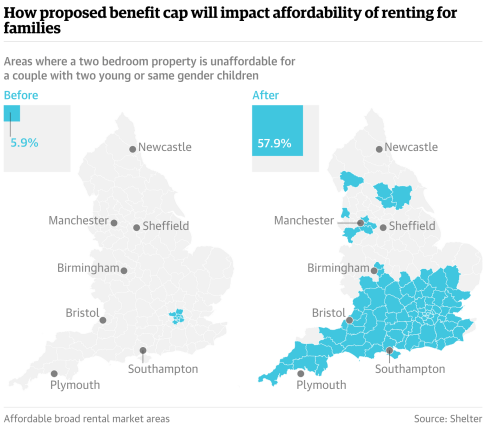
Benefit CapA cap of £20,000 a year has been placed on the amount of housing benefit people can claim. This has left large areas of the country, especially in London and the south east, completely unaffordable for families. The cap has even been put on sheltered or supported housing, meaning that 50,000 of the most vulnerable people – the elderly, people mental health problems, victims of domestic violence will either have to pay the rent shortfall themselves or risk homelessness.

This also has an impact on housing associations who are left with tenants who can’t pay their rent, and insufficient funds for repairs and maintenance.
 

Screen-Shot-2015-07-20-at-21.43.16

Local Housing Allowance: The way that housing benefit is calculated for people in the private rental market has also changed. Before it was based on the median rate of private rental prices in an area, roughly in the middle. Now it is based on the bottom 30th percentile, i.e. under 30% of the rent.

The size of the area used to calculate this (called a Broad Market Rental Area) can be huge. So, for example, despite the fact that rental prices wildly differ in Exeter it is treated as one large area, and the LHA you receive in St Thomas’ is the same as if you were living in the city centre. So, wherever you are in Exeter, a limit of £350 per month for a house share, and £530 per month for a one bedroom flat.

It is particularly difficult for disabled people like myself. I live, by necessity, on the ground floor in the centre of town. Even though that is more expensive than a first or second floor flat and to live in central Exeter, I don’t get any more housing benefit to cover these extra costs.

Much has been made of the discretionary housing payment, but there are many more people needing extra financial help than there are funds for. Without my parents practical and financial support I would have faced the risk of homelessness or completely unsuitable accommodation for my needs.

Benefit Sanctions: I don’t have time to look fully into the dangerous and inhuman system of benefit sanctions for people on JSA or ESA. Reasons for sanctions include not attending an appointment because you had a heart attack, and not looking for jobs because it is Christmas day.  Sanctions mean that people are left penniless, forced to go to food banks just to be able to eat, and if they can no longer pay the rent themselves, are evicted. Little research has been done, but over half of housing organisations report their clients have been made homeless as a result of sanctions. Although housing benefit should continue even when someone is sanctioned, often it is stopped because ‘claimants are required to … inform their local council – which administers Housing Benefit – that they have been sanctioned, otherwise their Housing Benefit’ may automatically stopped.

Sanctions also disproportionately effect the homeless with a third reporting that their job seekers had been sanctioned. For those who have have mental health problems or drug or alcohol addictions the rare it is even higher. Those in temporary accommodation who lose their HB are often evicted, making them more likely to return to the streets. The stress of sanctions can lead to worsening of mental and physical health problems and a return to substance abuse. One homeless man said: “During the time of sanctions I was thinking it would have been a lot easier being on the street “.

Lower Wages, Soaring Rents: It is easy to think that the risk homelessness will only effect people who are out of work, but soaring private rental prices and low wages mean that even those in work can struggle to pay the rent.Two thirds of families beneath the poverty line are in working families, and one in ten parents are having to skip meals to be able to pay the rent. In a recent BBC documentary on homelessness there was a young man who was working full time in London, but still couldn’t afford to live in a shared house and was sleeping on his friends floors.

And the situation is becoming worse. Whilst real term wages has dropped since the 2009, rent has increased. In the last year alone it has risen by nearly 12%. To make up the short fall between wages and rent there has been a huge increase in claims for housing benefit. Between 2014and 2015 the proportion of private renters in work and on housing benefit increased from 14% to 18%. The housing benefit bill now stands at about £9.5 billion pounds a year, much of which goes into the pockets of private landlords.

So what is behind the rise in rent? Basically there are too many people trying to rent too few properties. Housebuilding has dropped to an all time low, under the coalition government fewer than 150,000 homes a year were built when figures suggest 240,000 were needed to keep up with the demand.

Lack of Affordable Housing: People often think that social and affordable housing are the same thing, but they are very different. Affordable housing is just housing that people can actually afford to buy. It should really just be called housing. Rising house prices mean buying a house it now out of the reach of most people, even putting together a deposit is often too difficult. House prices are now almost seven times people’s incomes. This has led to a huge fall in home ownership, especially for young people. “In the 1980s, less than 20 per cent of 21-25-year-olds lived in private rents, now it is more than 60 per cent“. They are being dubbed as ‘generation rent’. Because people are not moving from renting to buying, this creates a further bottleneck, creating even more competitive in the rental market, there by driving rental prices up even further.

Lack of Social Housing:  Today there are 1.8 million people on the social housing list, an increase of 81% since 1997. In Exeter there are 4,300 people on the waiting list 486 households are classed as in ‘urgent’ need of accommodation. But despite this ‘over a third of the councils in Britain’  have built ‘not a single social rented home … in 2013/14”. This isn’t just a problem with today’s government. Margaret Thatcher’s government built more council flats and houses in a single year than New Labour’s managed in its entire period in office.

Not only are homes not being built, they are being sold off. The Right to Buy scheme is seeing homes being sold to tenants at  up to 70% less than their market value making it impossible for councils to build new homes. But that also isn’t just the Tory’s:  Under the labour government is estimated that it lost £4.5 billion were lost in the Right to Buy scheme.

These policies have led to a 300% increase in families in B&B emergency accommodation, even though they are at the top of the housing priority list. Because of the huge pressure on emergency accommodation people who are deemed at less high risk, such as adult men, often end up sleeping rough.

How to Reverse the Crisis: All this seems to paint a very bleak picture for the future but it doesn’t have to be like that. With political will behind it the situation could easily be reversed. It is imperative we revoke the legislation that penalises people for having an extra room, to not sanction the vulnerable, and to change housing benefit so that it is inline with actual rental prices. We must stop the Right to Buy scheme which is removing precious housing stock at cut prices, and stop the Help to Buy scheme which is just forcing up house prices further and plunging people into more debt.

Social Housing: The first step  must be to build more social housing. This would cut the housing benefit bill because rents would be lower. It would enable those who are now in temporary accommodation but are eligible for social housing to move out, freeing up space for those who are homeless and in need of emergency accommodation. It would lower prices in the private rental market because there would suddenly be fewer tenants, and when there is more supply than demand prices go down.

But how would this be possible?  There is no way the Conservatives are going dish out money to local governments.  The best thing to do would be to lift the bans on councils borrowing limits. At the moment councils who want to build more social and affordable housing are ham strung by strict rules on borrowing meaning that whilst private building companies are able to take out loans but local authorities can’t. 

“Around half of all councils are able to borrow only £10 million or less – enough to build only 80-90 homes. Some councils with pressing needs have no borrowing headroom at all – they include Greenwich (11,000 on their waiting list), Dudley (6,000), Exeter and Harrow (4,000 each)

By changing a single piece of legislation we would be able to start building some of the housing so desperately needed.

But this is only the start: Homelessness is just the tip of the iceberg of a huge housing crisis which affects everybody, whether a social or housing tenant or homeowners shackled with huge mortgages they struggle to pay. There needs to be a complete over hall to change housing from being simply a resource for speculation on the financial market to what it is meant to be: homes for people to live in.

But here are some Labour ideas to improve the situation:

  • The creation of a National Investment bank that could lend out money at low interest rates to councils and developers on the condition that they use it to build affordable and social housing.
  • Give councils greater powers to reduce the number of empty homes, including higher council tax on long term empty properties.
  • Lower regulated rents and better housing conditions in the private sector.
  • Private rents linked to local average earnings levels.
  • Tenants should have the right to longer tenancies.
  • Ability to tax or fine owners that hoard land without building on it.

This is an area where there is a lots of cross party unity. The Green Party also advocates building, 500,000 new social rented homes by 2020, bringing empty homes back into use, and ending the right to buy. This is a time to put aside party politics and work together, it is a too huge and important a task to fail on.


Leave a comment

Filed under Uncategorized

Violence as Disease – Why I’m against bombing Syria

Physician Gary Slutkin spent a decade fighting tuberculosis, cholera and AIDS epidemics in Africa. When he returned to America he began to see similarities between in the patterns of epidemics he had treated in Africa and the patterns of gun violence in his own country.

He figured the best way to fight gun violence was to treat it as a disease, to fight at the points of transmission. Retaliatory attacks did not solve the violence, they made it worse, and that preventing it spreading from one person to another was the only way to stop this epidemic.

The anthropologist Rene Girard said “Violence is like a raging fire that feeds on the very objects intended to smother its flames.” This is not just a philosophical point of view, the War on Terror has created more terrorism and more terror than would ever have been possible without western intervention. As Corbyn says “It is the conflict in Syria and the consequences of the Iraq war which have created the conditions for Isis to thrive and spread its murderous rule.”

xDeaths-from-Terrorism-2000-2014_branded1.png.pagespeed.ic.3QHOqb3iZe.png

Civilian deaths and the destruction of homes and infrastructure that is an inevitable consequence of intervention will be used by ISIL to support their view that the west is against them, and give credence to their continued violence. The people of Syria have been begging for international intervention for years, bombing to retaliate shows them the west will only act when they are personally attacked – that a French life is worth so much more than a Syrian one. And that protecting a French life at the cost of a Syrian civilian is acceptable. 

So what is the answer?

For Gary Slutkin is was to create a group of individuals called The Interrupters who, when there was gun or gang violence went and talked to the family and friends or other gang members before they had a chance to retaliate, calming them down, showing them other ways they can deal with the situation – in other words interrupting the vector (pathway) of the disease.

Corbyn’s idea to “to reach a negotiated settlement of the Syrian civil war – and end the threat from Isis” by international political intervention is a scaled up idea of Slutkin’s model of Interrupters. As many others before him – Martin Luther King, Ghandi, Nelson Mandela – have realised, non-violent action is the most successful form of long-term positive change. Even when so much of their community called for violence, they kept this belief in sight, and I hope that Corbyn will too.


Leave a comment

Filed under Uncategorized

The National Living Wage – the Biggest Tory Budget Con

Budget2 NLW Q1

Budget2 NLW A1

This was the face of Iain Duncan Smith on the announcement of the New Living Wage policy at Emergency budget…..

_84162494_telegraph

_84162989_mail

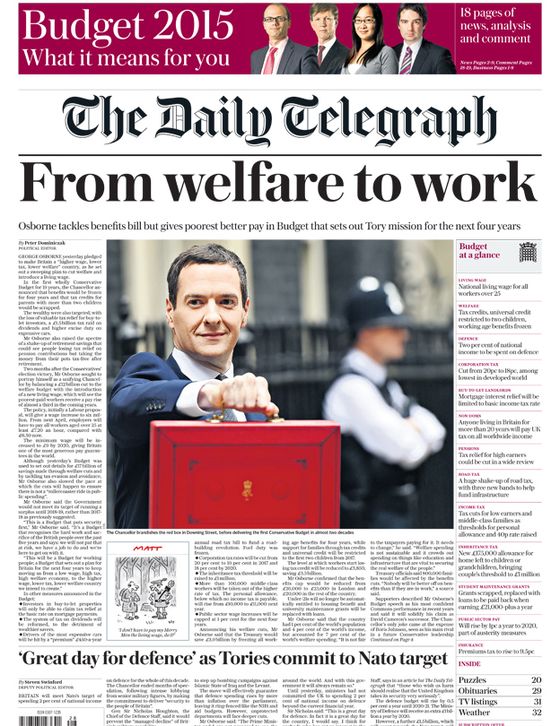
Clearly he seemed pretty pleased about it and as many mainstream papers agreed. But what is the truth behind the headlines?

Is the National Living wage the same as the Living Wage?

The Conservatives seem to have chosen to call what is essentially a new minimum wage the National Living Wage, making people and the media assume they are the same thing. But they are calculated in different ways and come out as different amounts – The Living Wage is £7.85/hr outside of London and £9.15 inside of London, whereas the National Living Wage is £7.20 and there is no enhanced London rate.

So how is the Living Wage calculated?

The living wage is calculated on behalf of the Living Wage foundation using information gathered by the Minimum Income Standard and is defined as the amount ‘households need to achieve a socially-acceptable living standard’.

It takes basic costs such as food, clothes, housing, transport, fuel, council tax and childcare into consideration but also includes broader necessities such as  ‘having what you need in order to have the opportunities and choices necessary to participate in society’.

An important point that neither the media or Conservatives have explained is that “its calculation is predicated on full take-up of tax credits, housing benefit… If in-work support is cut then … the Living Wage will rise. For example, if we exclude in-work support then the level of the London Living Wage leaps from £9.15 to £11.65; 80 per cent higher than the current minimum wage” The Resolution Foundation. 

It also assumes certain criteria e.g. that families will be living in low rent council properties, whereas the reality for many now (especially with the Right To Buy removing so much social housing) is living in expensive private rentals.

So, how is the National Living Wage calculated?

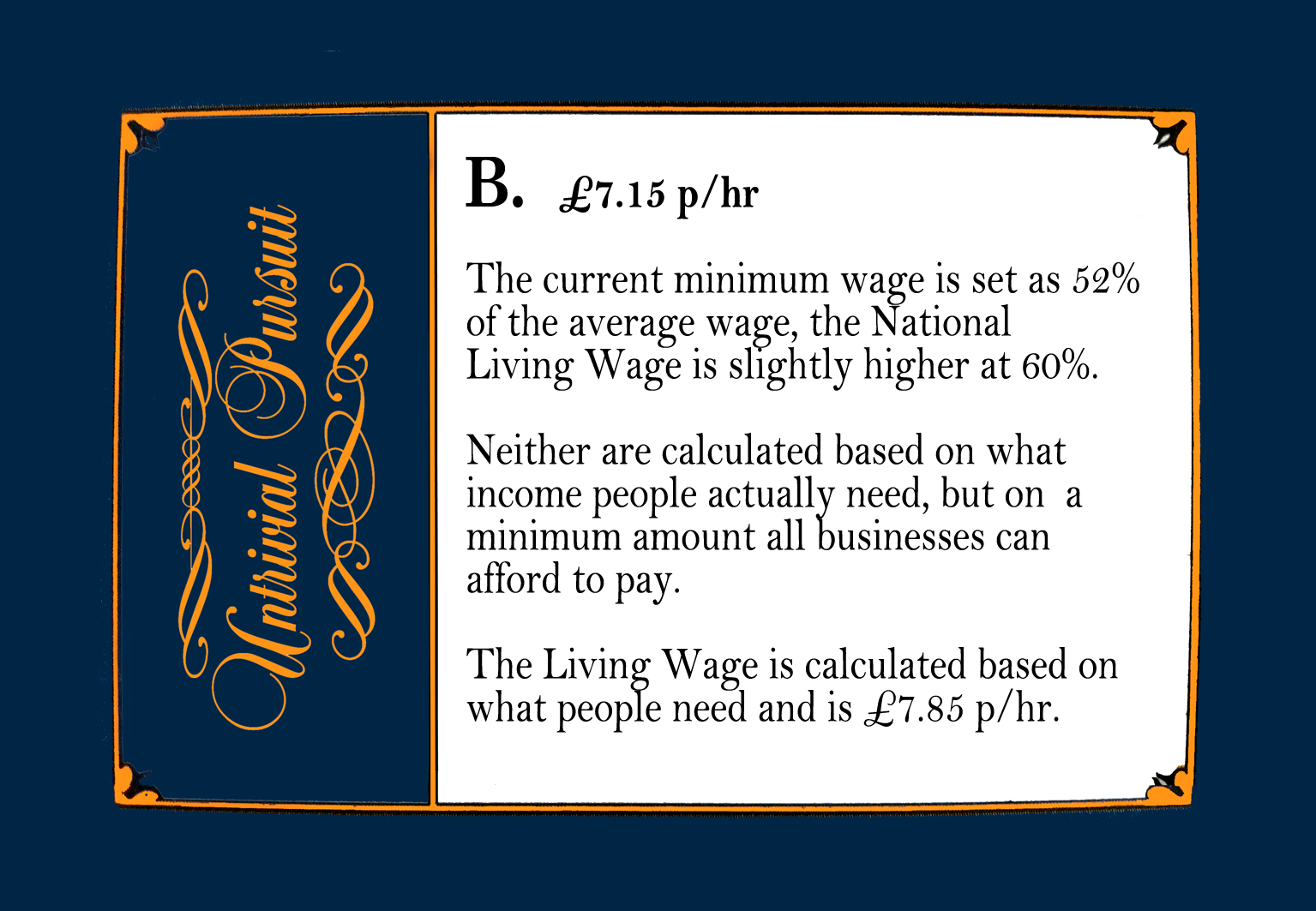
The current minimum wage, which is decided by the Low Pay Commission, currently stands at £6.50 p/hr. Although it is rising 20 pence in October to £6.70 p/hr . This is far below the £7.15 the government are setting out.

Minimum wage is currently calculated at 52% of median wages. The NLW is calculated as 60%. The government has asked the low pay commission to consider using the NLW as the minimum wage with the intention of raising it to £9/hr by 2020. Under 25s are exempt (inexplicably) and will continue to receive the minimum wage.

But its still a good thing, right?

Well, yes, of course having a higher minimum wage is a positive thing. It will raise the income of 2.5 million workers and reduce the government effectively subsidising private companies by using topping up people’s salaries. Osborne said “It can’t be right that we go on asking taxpayers to subsidise, through the tax credit system, the businesses who pay the lowest wages.” and I agree with him. Most people on minimum wage work for big companies with huge profit margins who can easily afford to pay a decent wage.

The problem comes with the notion that the higher NLW will compensate for tax credit reductions and benefit freezes.  It is the carrot the conservatives are using as the compensate for the stick of brutal welfare reforms by saying they are moving the country from “a low wage, high tax, high welfare economy, to a higher wage, lower tax, lower welfare society”.

Osbourne claims that “taken together with all the welfare savings and the tax cuts in this Budget, it means that a typical family where someone is working full time on the minimum wage will be better off.” This is not true. 

So what’s the cost?

Thirteen million families will be affected, with three million losing £1000 per year on average.  Even taking into account higher wages, people will be “significantly worse off…There is simply not enough money going in to the New Minimum Wage to anywhere near compensate – in cash terms – people on tax credits” Paul Johnson IFS And very ironically, considering the Work not Welfare rhetoric of the Conservatives, the tax cuts will hit those who are on the lowest wages even more than those on benefits, making it even harder for people to transition from benefits to work.

_84181797_tax_and_benefit_reforms_624gr

Leave a comment

Filed under Uncategorized

The truth about what the child tax credit changes really mean

Budget 1 Q&A

Budget 1 A

As of 2017 the poorest families could lose up to £2,780 a year in child tax credit. The measures come in as part of major cut backs that will affect up to 13 million families.

What is Child Tax Credit?

It is easy to get child tax credit and child benefit confused. Child benefit is non means tested and given to all parents, and it will continue unchanged. Child tax credit is means tested top up for families with low incomes, whether parents are on benefits or working.

So who will be affected?

At the moment you are eligible for child tax credits for all of your children. The more children you have the higher the minimum income needs to be meet the minimum  threshhold e.g £26,000 for one child, £45,400 for 4 children. After April 2017 you will only be able to claim for your first two children no matter how many you have.

However it is not only those with more than 2 children who are being affected.

At the moment, any household earning up to £6,420 a year claims the full amount of whatever tax credits they’re allowed to claim. This threshold is now being almost halved to £3,850 a year.

The government has also scrapped an aspect of the benefit called the family element which is paid to all families eligible for child tax credit, and means the loss of a further £540.00

‘But it doesn’t come into effect until 2017 so it won’t affect me’

The government have said that the new rules would only affect new claims made after April 2017, so their current credits won’t be affected. However there is a loophole will count families as a ‘new claim’ if they’ve had a 6-month break in claiming tax credits.

And those who already have three children – but who claim for the first time after April 2017 – will also count as a ‘new claim’, meaning they only get paid for two children.

That means anyone who lifts themselves out of poverty for a long stretch but then loses their job again will lose thousands of pounds. Anyone who didn’t need to claim them but loses their job or becomes too ill to work will also be viewed as a new claim.

Given the Conservative repeating mottos of supporting working families and ‘making work pay’ this is more likely to discourage people to work.

Many people think that tax credits are for families on benefits, but most claimants have one or both working parents. In fact 2/3 of children living in poverty are in working households.

Will it work?

The ideology behind this move is clearly to discourage people from having large families if they are on low incomes, but there is no evidence to say this will happen – whether it is 1 or 2 or 6 children child poverty does nor present children being born. In fact the Blair government brought in the tax credit system because so many children were living in poverty, and the IFS says that “the substantial falls in child poverty were driven by very significant additional spending spending on benefits and tax credits”.

Are there any exceptions?

Yes. Disabled children will have their benefits protected, as will multiple births as well as other ‘exceptional circumstances’ but there is no detail on what those are or who would make the decisions. Women who have become pregnant through rape are also protected, but there is a fear that:

“Asking women to disclose very difficult information and expecting them to be able to prove it – in what is frankly a very hostile environment when the DWP is trying to take your money away – will have appalling consequences.” Lisa Longstaff Women Against Rape.

The idea behind these exceptions if clearly that some pregnancy’s are seen as not the women’s ‘fault’ prompting  a worrying onus on the responsibility of women to not become pregnant, and the ‘punishment’ of not receiving tax credits if they do. But there are situations – due to culture or faith – such as catholics, where contraception is not an option for women. Unplanned pregnancies are also common, and not just because people don’t use contraception. Do we want women to be held responsible for one missed pill or have one burst condom? Do we want a society where unplanned pregnancies have to be aborted because someone is too poor to raise a third child without financial support?

Who will really suffer?

The conservatives call this reforms “not easy but fair”, but the true weight on them will not fall on society, or even the parents of these children, but on the children themselves. To whom we are born – rich, comfortably off, or very poor – is the ultimate wildcard. It seems deeply unfair that the ones most affected – the children – who are without choice at all. Child poverty affects the education, mental and physical health and even lifespan, and the effects of it are estimated to cost wider society up to £29 billion a year, more than the government is saving through these austerity measures. The least we can do as a compassionate nation is try to level the playing field for those born into poverty to give them a better life.

Leave a comment

Filed under Uncategorized

It Ain’t Over Till the Fact Lady Sings – Untrivial Pursuit Two Months On

As many of you know I created a game called Untrivial pursuit. In the month prior to the election, each day I posted a question about a common political or economic misconceptions and misinformation, later revealing the real answer on this blog.

I also took the game out to the streets to play with passing strangers, educating them about topics like immigration, benefit fraud, whether public debt was increasing or decreasing.

I kind of thought that after the election I could put the project to bed, after all I had created it to help people make informed choices when it came them casting their votes.

But 2 months on there is still a gulf between the truth and how media and politicians misrepresent it and conceal it.

Yesterday Greece voted against implementing the austerity measures that the EU have demanded, showing the real power that a government can give its people that goes beyond merely deciding who should be in parliament.

Contrast this to our Conservative government who tomorrow are delivering an emergency budget that will see cuts to working tax credit, the NHS, social care and will affect some of the most vulnerable people in society. And they are doing this even in the face of massive anti-austerity protest.

So I shall be continuing to fight misinformation and misrepresentation with truth and clarity. For after all, it ain’t over until the fact lady sings…

Leave a comment

Filed under Uncategorized

Day 30 answer…

Q.17 House Building A1


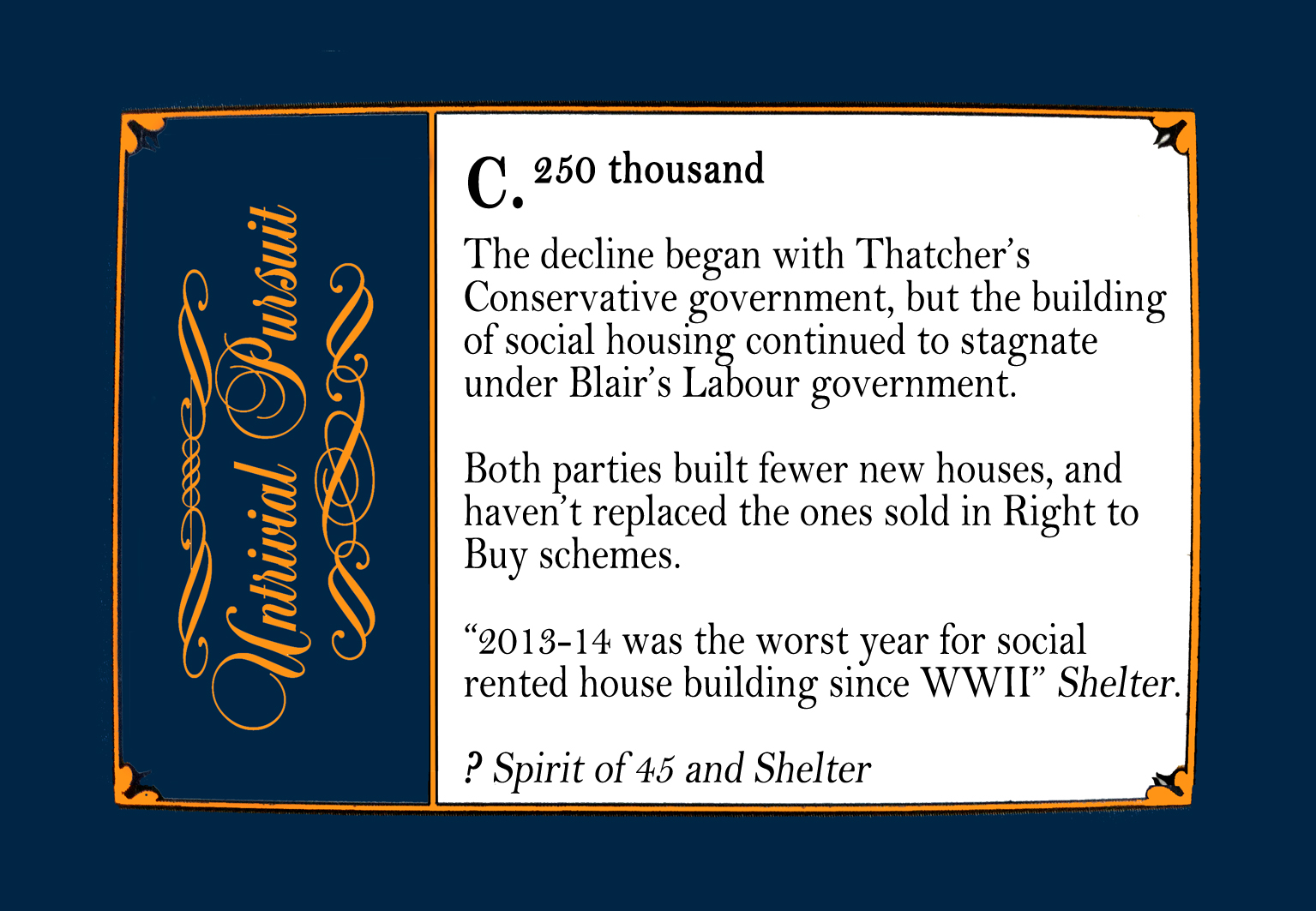
Today there are 1.8 million people on the social housing list, an increase of 81% since 1997. The main reasons for this are:

A lack of social housing being built:


“In 117 council areas – over a third of the 326 in England – not a single social rented home was built in 2013/14” Shelter

‘Right to Buy’

Thatcher came up with the ‘Right to Buy’ scheme – allowing those in council housing to buy their council homes at below market value. In 1982 alone 200,000 homes were bought under the scheme and since then 1.5 million homes have been sold since then.

By selling off houses at  a discounted, below market rate, councils are losing money – under the labour government it was estimated that it lost £4.5 billion – and it is getting worse: recent government changes mean councils can sell off their social housing for up to 70% less than their market value.

What is particularly galling is that when people buy their homes, they are allowed, after an initial period, to sell them off at market value, or, as has happened in at least 33 local councils, for owners to rent out their houses to people on housing benefit at private rental value.

So what is the answer?

The best thing to allow more social housing to be built is to lift the cap on council borrowing:

“one obstacle that could be tackled if government wanted to is the borrowing caps that were imposed when self-financing began. They stop many councils from making extra investment that could easily be paid for from their rental incomes” Chartered Institute of Housing

This would put councils on equal footing with private developers, and create enough social housing to meet the needs of the 1.8 million people in desperate need of social housing.


Leave a comment

Filed under Uncategorized

Day 30 Question…

Q.17 House Building Q1

Leave a comment

May 6, 2015 · 11:30 am

Day 28 answer…

Tax Avoidance A

Leave a comment

May 4, 2015 · 7:30 pm

Day 28 question…

Tax Avoidance A

Leave a comment

May 4, 2015 · 11:30 am

Day 28 question…

Tax Avoidance Q

Leave a comment

May 4, 2015 · 11:30 am